SeqNexus

A free plasmid editor and molecular biology bench, in a browser tab.

Edit and annotate sequences, draw plasmid maps, plan a cloning strategy, design primers and guides, align, read chromatograms, map NGS reads. Everything is computed on your own machine.

Free to use. No installation, no account, and nothing leaves your device.

3,510 3,520 3,530 3,540 3,550 3,560 3,570 3,580 3,590 3,600 3,610 A T A T T A A T T A T A G C T A T A G C A T T A G C C G G C C G T A G C G C C G A T G C T A G C T A T A C G C G T A G C C G G C C G C G G C G C T A T A G C C G A T T A T A C G G C A T T A T A C G C G T A G C T A T A T A G C T A A T A T T A T A G C T A C G C G T A T A T A T A A T A T C G A T G C C G G C A T T A C G G C C G G C T A A T T A T A T A C G G C T A C G T A C G G C C G T A C G A T G C G C C G G C C G A T A T T A C G A T C G G C A T A T T A G C KanR CDS 3,156..3,965 · aminoglycoside phosphotransferase · 269 aa N I V D A L A V F L R R L H S I P V C N C P F N S D R V F R L A Q A Q S R M PvuI CGATCG · cuts once · 3' overhang KanR_fwd Tm 60.0 °C · 50 % GC · no hairpin sgRNA 3 SpCas9 · PAM CGG · on-target 71 · no off-targets at 3 mismatches coverage 412× mean · 2 × 150 bp paired c.419A>C p.(Asn140Thr) · missense · A>C in 397 of 412 reads · 96 % 3,570 3,580 3,590 3,600 T A G C T A C G C G T A T A T A T A A T A T C G A T G C C G G C A T T A C G G C C G G C T A A T T A T A T A C G G C T A C G T A C G G C C G T A C G A T G C G C KanR CDS · 269 aa C P F N S D R V F R L A Q PvuI cuts once · 3' overhang KanR_fwd Tm 60.1 °C · 59 % GC sgRNA 3 SpCas9 · PAM AGG · on-target 71 coverage 412× c.431T>A p.(Val144Glu) · 96 % of reads

pDONR221, positions 3,504 to 3,617positions 3,564 to 3,603 of the kanamycin resistance gene: a guide with its PAM and cut, a primer with its Tm, the PvuI site, the reading frame, a variant named as HGVS names it, and the reads that called it.

01The bench

Every tool a cloning project needs, in one place.

From the first plasmid file to the verified clone, without switching programs. Each item below runs client-side, from short oligos up to genome-scale sequences.

The full feature list, with screenshots →

02In practice

Three things it does that you would otherwise need three programs for.

Cloning

Plan the construct on the map, then order the oligos.

Click the cut sites on each part's own map and watch the reaction strip assemble the product. Seamless assembly, Golden Gate with overhang fidelity, Gateway and TOPO follow the same path, and the junctions, oligos and verification digest come out at the end.

About cloning →
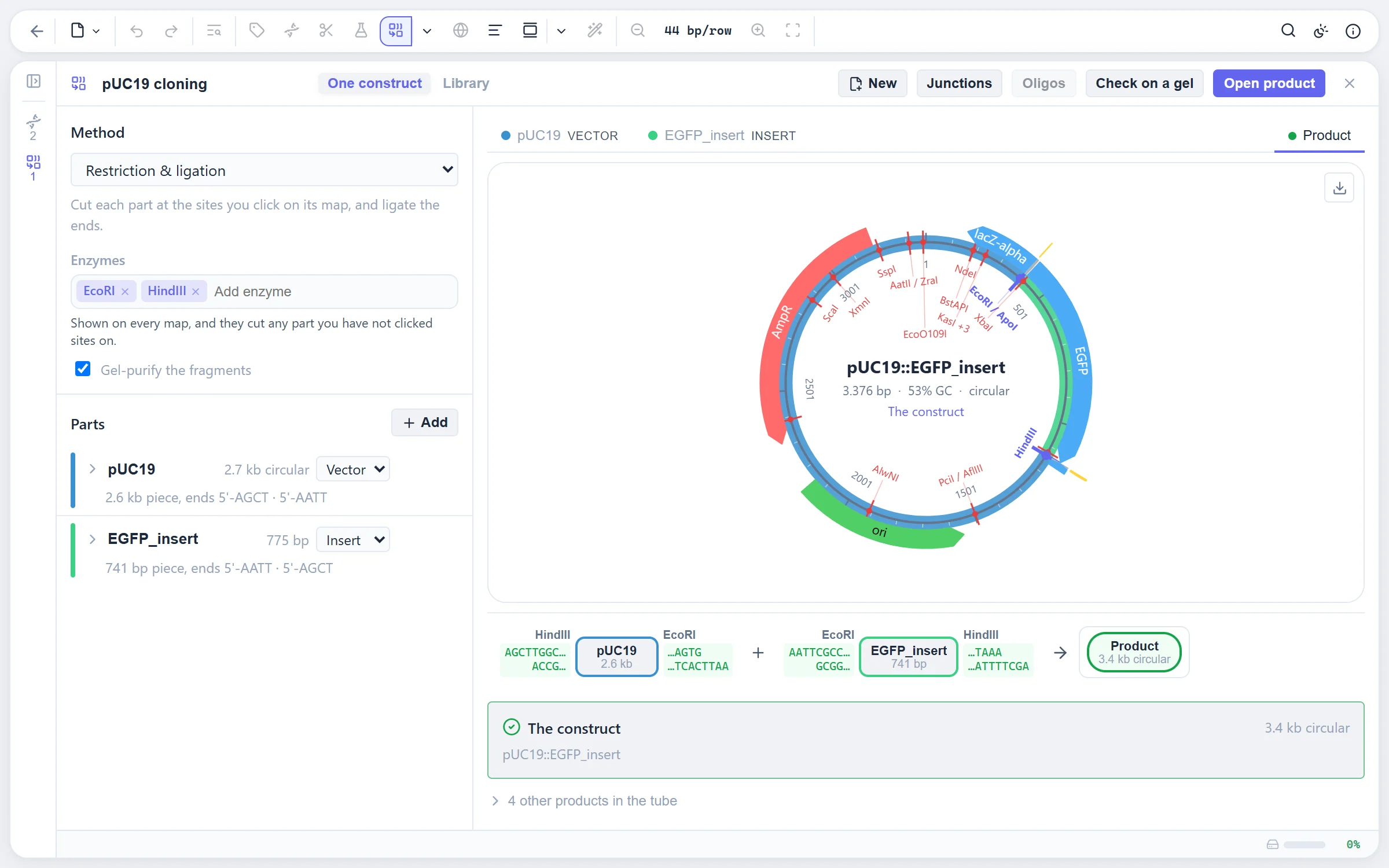
The cloning workspace with a vector and an insert map and the reaction strip

Reads

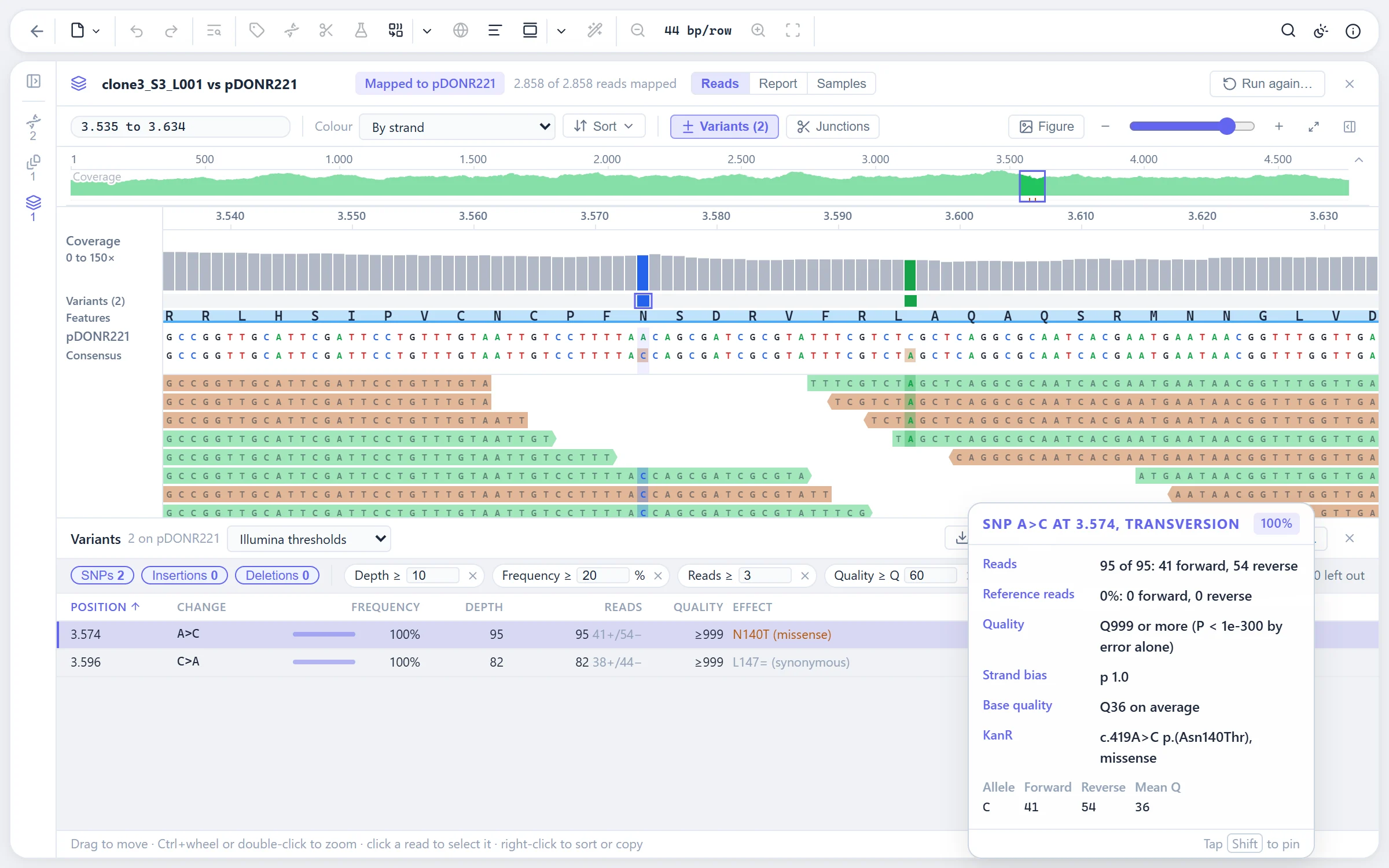
Map a FASTQ to your reference without leaving the tab.

Import a read set, read its quality report, trim it, and map it with minimap2 running in WebAssembly. Coverage, reads coloured by strand or pair, and variants with their effect on every coding feature, named the way HGVS names them.

About mapping →
A read mapping with coverage track, reads and called variants

CRISPR

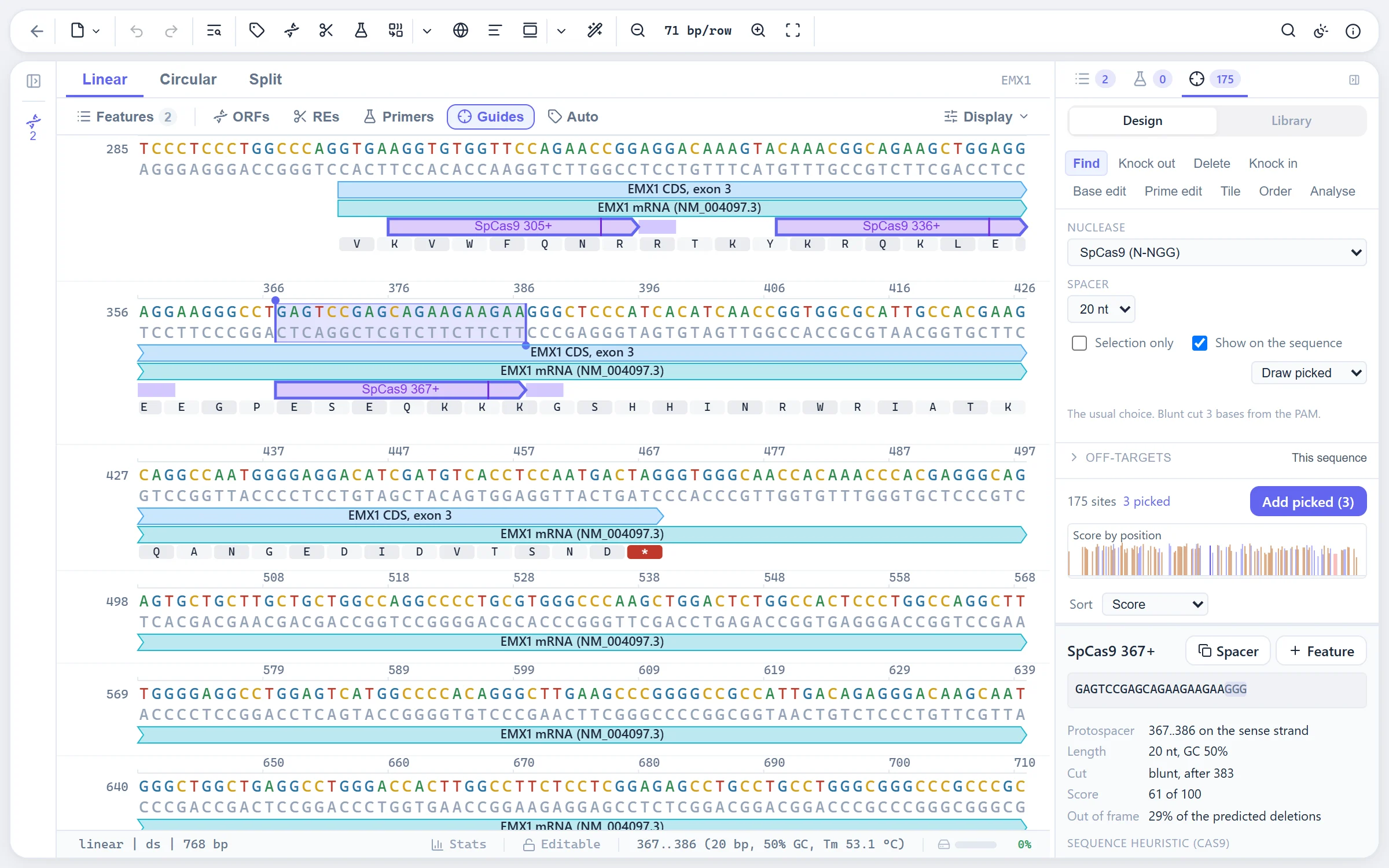
Pick a guide, check it against the whole genome, read the edit back.

Protospacers for a dozen nucleases or one you describe yourself, scored for activity and for the repair the break is likely to get. Off-targets with mismatches and bulges, donors that will not be re-cut, pegRNAs built in their pieces, and the edited chromatogram taken apart against its control.

About guide design →
The CRISPR guide designer with scored guides drawn on the sequence
1 1,000 2,000 3,000 4,000 rrnB T1 attP1 ccdB cat attP2 KanR ori pDONR221 4,762 bp

pDONR221, drawn from its GenBank record

03Local first

Your sequences never leave your machine.

There is no server. The page you open is the whole program, and every alignment, digest and mapping is computed in your browser.

  • ComputedIn Web Workers and WebAssembly on your own CPU. Long jobs run in the background and can be cancelled.
  • StoredIn your browser's IndexedDB, auto-saved as you work. Export a session file to move it to another machine.
  • OfflineLoad the page once and it keeps working without a connection. Only NCBI, UniProt and BLAST need the network, and only when you ask.
  • OpenThe source is on GitHub under the AGPL. The README explains every method, its parameters and the papers behind it.

04Interchange

Reads and writes the files you already have.

Drag a file onto the window, or fetch a record straight from NCBI or UniProt.

Reads
  • GenBank.gb .gbk
  • GenPept.gp
  • FASTA.fasta .fa .faa
  • FASTQ.fastq .fq .gz
  • SnapGene.dna
  • Geneious.geneious
  • AB1.ab1
  • SCF.scf
  • GFF3.gff3
  • SAM.sam
  • BAM.bam .bai
  • Plain text
Writes
  • GenBank
  • GenPept
  • FASTA
  • FASTQ.gz
  • SnapGene.dna
  • SAM
  • BAMwith index
  • VCF
  • GFF3
  • CSV
  • Clustal.aln
  • PHYLIP
  • NEXUS
  • SVG
  • PDF
Fetches from
  • NCBI Nucleotide
  • NCBI Protein
  • UniProt
  • NCBI BLAST

SnapGene and Geneious files are read with parsers written for this project, so features, primers, topology and methylation come across. Sessions can be exported whole and reopened on another machine.

05Free

Free to use.
Not a trial, not a tier.

There is nothing to pay and nothing to unlock. Every tool on this page is available to everyone, for academic and commercial work alike, and all output may be used in publications, theses, presentations and products without restriction or fee. If it ends up in a paper, a citation is the one thing asked in return; the reference is beside this.

SeqNexus is open source under the GNU AGPL v3, with the full source on GitHub. Bug reports and suggestions are welcome there.

Cite SeqNexus

Acatay, C. (2026). SeqNexus: a browser-based molecular biology sequence editor. Available at https://seqnexus.app

Get started

Nothing to install. Open the tab and drag in a file.

The editor is a single self-contained page. Load it once and it keeps working offline, with your sequences stored on your own device.